



The body of Iran’s supreme leader who was killed in US-Israeli strikes that triggered the Middle East war arrived at Tehran’s Grand Mosalla on Friday ahead of his funeral, state media reported.
Millions of people and a coterie of foreign dignitaries were expected to attend Saturday’s official ceremony for Ali Khamenei, with Tehran’s chief negotiator calling for a massive turnout to avenge his death, said AFP.
Photos showed mourners carrying Khamenei’s coffin, emblazoned with Iran’s tricolor flag, into the Grand Mosalla, one of the Iranian republic’s most important ceremonial venues.
Others show crowds at a pre-funeral ceremony clad in black, as the coffin is set down against a backdrop of red flowers and white butterflies hanging in the air.
Preparations for Khamenei’s public funeral, initially delayed at the height of the war, are taking place as Iran and the United States observe a fragile ceasefire after signing a preliminary deal to halt the conflict.
Pakistan, a key mediator in the US-Iran talks, said its Prime Minister Shehbaz Sharif would attend the ceremony.
China, Afghanistan and Iran’s neighbors in the Caucasus region said they would also be sending representatives.
Workers were readying the Grand Mosalla on Thursday, while security teams stopped passing cars and curious bystanders looked on.
“We are planting flowers and watering the shrubs for the farewell ceremony of our martyred guide,” said worker Hossein Moghadassi, clad in a hat and a scarf to cover his face as the temperature soared.
“People will come from all over Iran. There will be huge crowds.”
Tehran’s chief negotiator Mohammad Bagher Ghalibaf had called on Thursday for “all the Iranian people…to write a glorious page in the history of Iran through your presence.”
“The nation’s call for vengeance must ring in the ears of the whole world,” Ghalibaf, who is also Iran’s parliament speaker, added in a statement.
Khamenei, a spiritual figure for many Shias, was killed at the age of 86 in strikes on his compound in the center of the Iranian capital.
He will lie in state for three days at the colossal Grand Mosalla, which has been draped in banners featuring images and quotes of Khamenei.
The bodies of his slain relatives will also be presented.
– Multi-city commemorations –
The ceremonies are expected to draw between 15 and 20 million mourners, according to officials, which would make it the biggest state funeral in the country’s history.
Ghalibaf called it “one of the most significant moments” in Iran’s history.
Tehran, as well as the holy cities of Qom and Mashhad, which will host later stages of the funeral and burial ceremonies, will observe public holidays while the events are underway.
Authorities have ordered public and private offices in Tehran to close from Saturday through Monday, while traffic restrictions will make much of the city center inaccessible to private vehicles.
The airspace over Tehran will be partially closed from Friday and fully closed on Monday.
Following the ceremonies in Tehran, Khamenei’s body will be taken to the Iraqi holy cities of Najaf and Karbala before his burial on July 9 at the shrine of Imam Reza in the northeastern Iranian city of Mashhad, his birthplace.
It remains unknown if Khamenei’s son and successor Mojtaba, who has not been seen in public since becoming supreme leader, will be present at the main ceremony in Tehran.
Representatives from around 30 countries are expected to attend the funeral, with people pouring in from neighboring Iraq, Afghanistan and Pakistan.
Ukraine and Russia on Thursday vowed fresh assaults in their four-year war after Moscow launched a massive barrage on Kyiv, killing at least 21 people, tearing open apartment buildings and sending tens of thousands to shelters.
Ukrainian President Volodymyr Zelensky said his forces would “definitely” retaliate for the overnight pummeling of the capital as he inspected the site of an apartment block partially destroyed in the attack, AFP reported.
In Moscow, the Kremlin vowed to further ramp up the “pressure” on Kyiv, sticking to its no-compromise rhetoric as rescuers in Kyiv scoured the rubble for survivors.
The European Union’s top diplomat proposed new sanctions on Moscow, while Zelensky asked the United States for licenses to manufacture Patriot air defense missiles.
Russia has routinely launched waves of missiles and drones at Ukrainian cities during its invasion, which has become Europe’s deadliest conflict since World War II.
AFP journalists in central and eastern Kyiv heard more than a dozen explosions and saw residents — some with children and pets — rushing to shelter in metro stations.
In the morning, locals stood on the rubble of destroyed apartment blocks ripped apart by the barrage, as smoke poured over the Kyiv skyline.
At one spot, a mother cried as she embraced her son in front of the smoldering debris.
Blasts started echoing out late on Wednesday, lasting into the early hours of Thursday as Russian missiles and drones rained down on residential areas in the city center.
Mayor Vitali Klitschko described it as the “enemy’s most massive attack on the capital”, without elaborating.
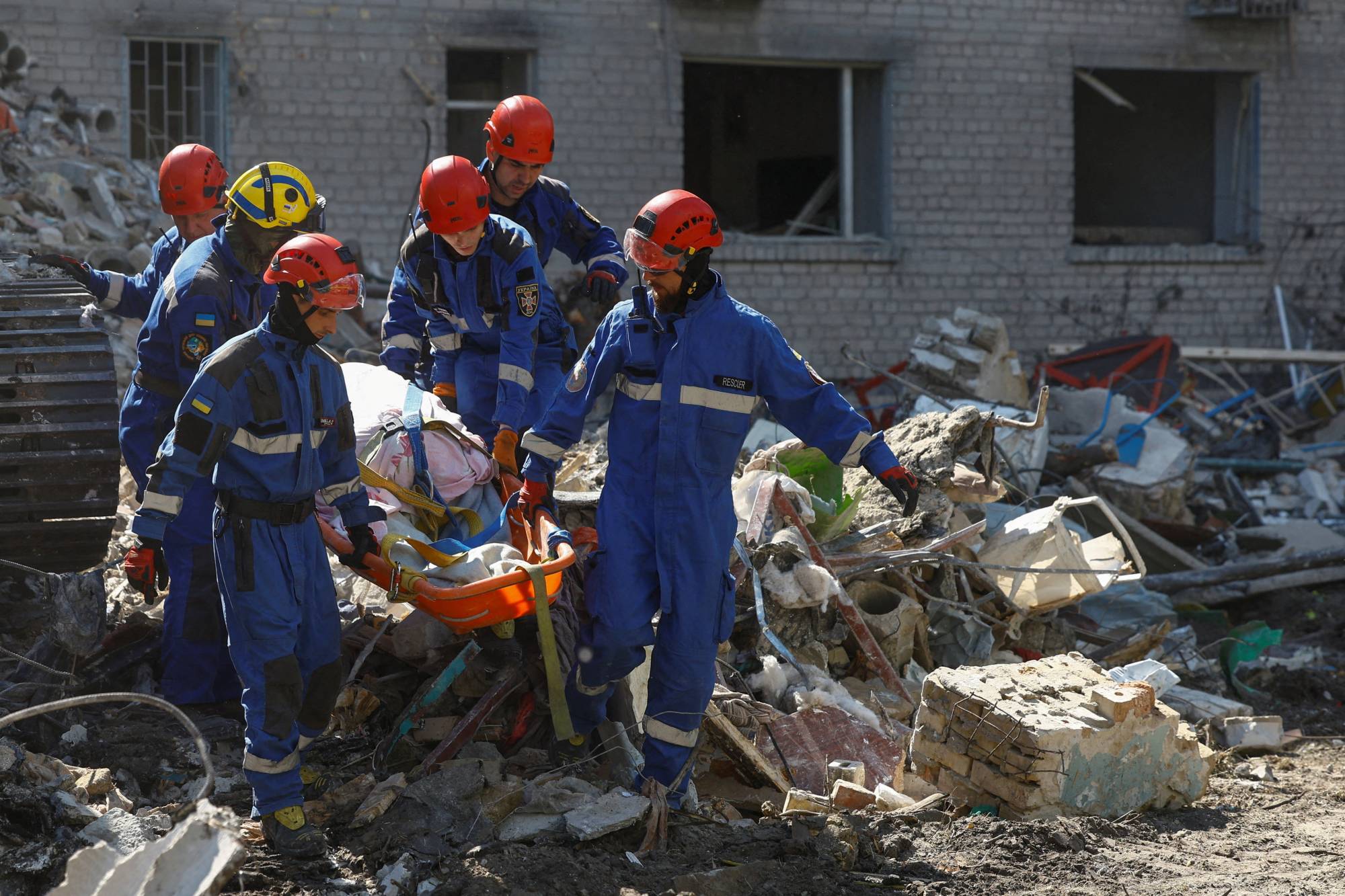
The state emergency services said at least 21 people were killed and 85 were wounded, including two children.
The Ukrainian branch of the Red Cross said that its key warehouse was “destroyed” in the attack with around $2 million worth of humanitarian aid lost.
Debris from the pummeling also damaged a building that was “hosting a number of diplomats”, EU spokesperson Anitta Hipper told AFP, adding that “EU diplomats were affected” but “safe”.
Kyiv urged its allies to send more air defense.
“Air defens supplies for Ukraine are an absolute and critical priority,” Zelensky said in a post on Facebook.
“We also very much count on a decision by the United States regarding licenses for Patriots.”
Ukraine is seeking to manufacture munitions for the US-made missile interceptor system, one of its only ways of defending against Russian ballistic missiles, although defense experts say it will take time to set up production domestically.
Russia fired 496 drones and 74 missiles, including hard-to-intercept ballistic projectiles, Ukraine’s air force said.
It said it shot down 48 of the missiles and 476 drones.
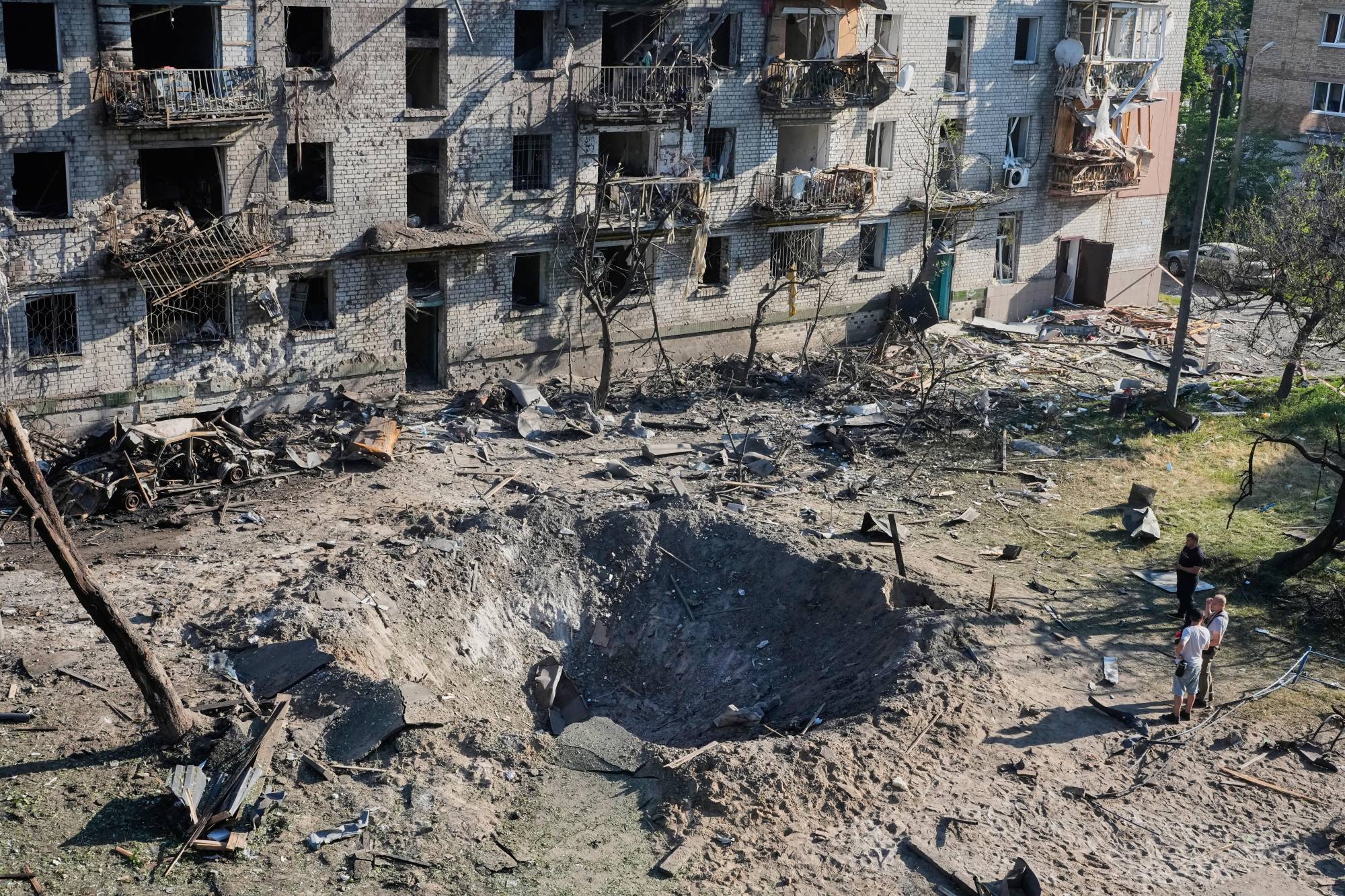
AFP reporters met several Kyiv residents outside an apartment building largely destroyed in the attack.
“Half the building has been destroyed. The roof is gone,” said 32-year-old factory worker Sabina Mambetova, standing outside the rubble of her home in the eastern Darnytskyi district.
“I’ve been left without an apartment, alone with my child. I don’t know what to do now.”
An AFP journalist at the site saw rescuers extracting the body of another victim of the attack, which ripped a multi-story building open.
Some 52,000 people, including 4,500 children packed into underground stations to shelter from the barrage — the highest number in recent years, according to the Kyiv metro.
Others hunkered down in basements or corridors through the night as blasts shook buildings across the city.
“It’s hard. My child is used to sleeping in complete silence and darkness,” 32-year-old doctor Kateryna Kucheryava told AFP from the metro as the attack was unfolding.
“I picked her up and carried her down. She woke up and now she’s not sleeping anymore.”
Along station platforms, locals set up tents and lay on air mattresses and camping chairs, while mothers tried to sleep clutching babies to their chests.
The EU’s top diplomat Kaja Kallas said she would propose new sanctions on Moscow over the attack.
But the Kremlin showed no signs it would back down, more than four years into an invasion that has killed hundreds of thousands.
The attack came hours after Zelensky cut short a visit to Dublin on Wednesday, citing intelligence reports of an impending Russian strike.
Zelensky said Russian President Vladimir Putin “has been preparing this massive strike against Ukraine for some time now”.
Ukraine has stepped up long-range drone attacks inside Russia in recent weeks, targeting energy infrastructure and military targets.
Russian officials have reported repeated strikes in border regions, while Moscow has said its air defenses have intercepted hundreds of drones from Ukraine in recent days.
US efforts to broker an end to the conflict have so far failed.
Hunger across Nigeria’s conflict-hit north is at levels not seen in a decade as violence spreads and aid shrinks, the UN’s World Food Program warned Thursday, with more than three million people “acutely food insecure”.
The country has been battling an extremist insurgency centered in the northeast since 2009, with a resurgence in violence since 2025.
Extremists have also been expanding into the northwest, which is already facing a separate, overlapping crisis from armed “bandit” gangs.
“What concerns us most is how this crisis is expanding,” WFP regional director for west and central Africa, Kinday Samba, said in a statement, noting the spread of violence “across a much wider area and forcing people from farmland, driving displacement and restricting humanitarian access”.
Aid cuts under US President Donald Trump and other western countries have hit some of Nigeria’s poorest households in recent years.
At the same time, the International Monetary Fund reported last month that poverty has risen under President Bola Tinubu, who has embarked on a raft of economic reforms supported by economists but which have also driven punishing inflation.
As conflict in the country’s troubled north has expanded, so has the number of areas too dangerous for WFP to operate in, it said.
“The number of inaccessible locations has doubled: a further 15 areas are now considered partially inaccessible for WFP’s frontline staff,” it said,
Government control is scanty outside urban centers, leaving swathes of rural areas prone to attacks from armed groups.
More than 17 million people across northern Nigeria “are experiencing crisis, emergency, or catastrophic levels of hunger”, WFP said.
“Nigeria’s food security crisis is worsening faster than previously anticipated,” it said. “Conflict is driving hunger in some northern states, particularly the northeast, to levels not seen in almost a decade”.
In Borno state, the epicenter of the militants conflict, more than three million people are “acutely food insecure”, including 10,000 people facing “catastrophic hunger”.
But WFP’s footprint is shrinking amid a donor shortfall, it said.
At the height of 2025 “lean season”, when the previous year’s foodstocks are running low but the current year’s crops aren’t ready for harvest, the agency delivered food and nutrition aid to 1.3 million people.
Amid “extreme funding shortfalls”, it has projected it will reach slightly over half that number this year.
Iran’s joint military command warned Thursday that all oil tankers moving through the Strait of Hormuz must use its approved routes or face a “forceful response,” again ratcheting up tensions over a waterway crucial for international energy supplies.
The strait, the narrow mouth of the Arabian Gulf, has emerged as one of the top issues in negotiations to reach a permanent end to the Iran war. The statement from the Khatam al-Anbiya military command, reported by Iranian state television, comes after both US and Iranian diplomats met with mediators on Wednesday in Qatar, The Associated Press said.
It wasn’t immediately clear what sparked the threat from Iran. However, the US military’s Central Command had put out a statement about having a meeting with officials from Mideast nations in Bahrain that said “leaders underscored their shared commitment to the free flow of commerce through the Strait of Hormuz.”
“Any failure to comply, deviation from the designated route, or disregard for the navigation protocols of the Islamic Republic of Iran in the Strait of Hormuz will be met with an immediate and forceful response from the armed forces, endangering the security of the violating vessels,” the Iranian statement said.
It also said the continued presence of US fighter jets over the strait “causes insecurity in this waterway and threatens regional security.”
“Any attempt by the United States to interfere in security matters or any disruptive action in the Strait of Hormuz will be considered a threat to Iran’s national sovereignty and will be met with a rapid and decisive reaction,” the Iranian warning added.
Iran and the United States agreed as part of an interim deal to allow ships to pass without paying charges for 60 days. But Tehran insisted it must control the routes of the vessels and later charge fees for passage, upending decades of practice in the waterway.
An effort by Oman and a United Nations agency to launch a new route near Oman’s shore sparked attacks across the Mideast last weekend, highlighting the tensions.


Leave a comment